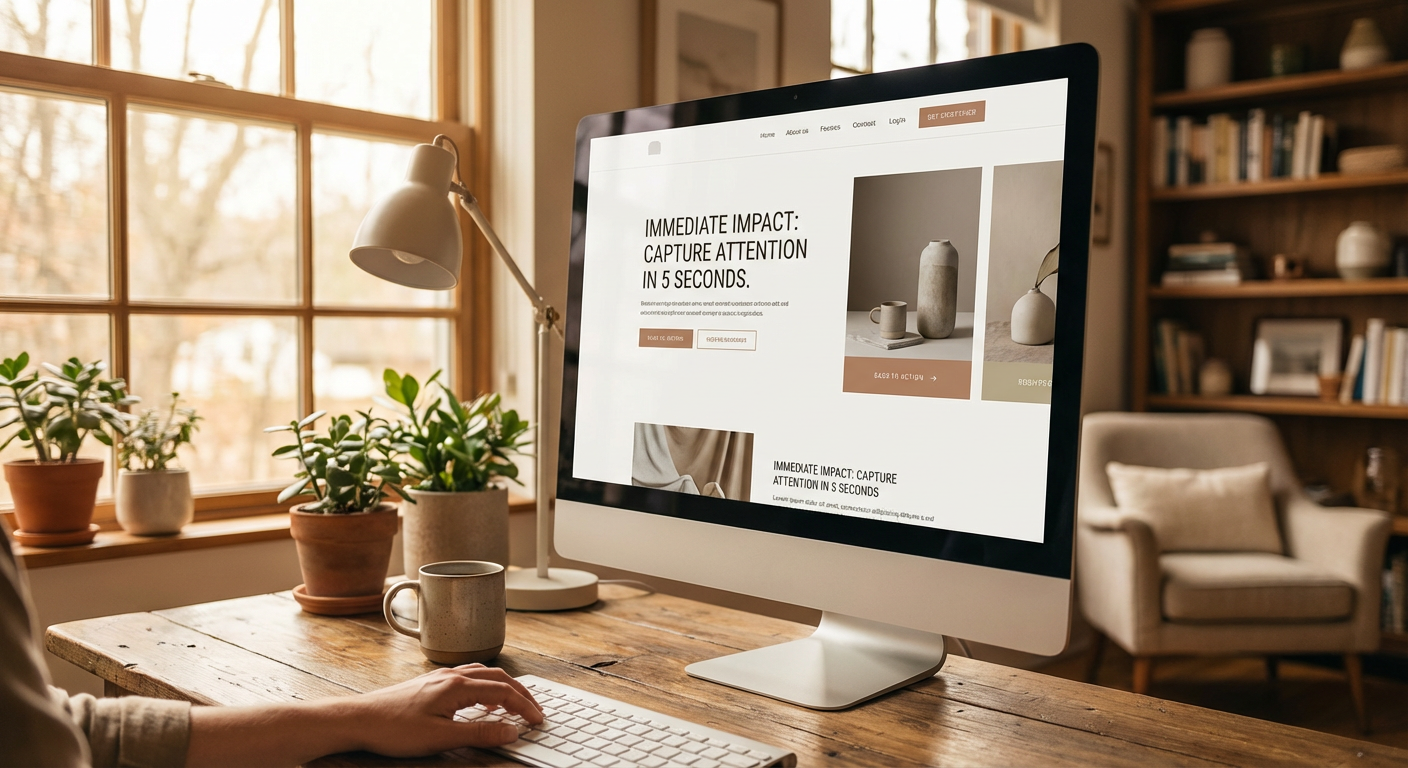
Hero Sections That Actually Convert Visitors
Learn about hero sections that actually convert visitors and how it impacts your business website. Practical insights from FunnelDonkey, St. George Utah's pr...

Hero Sections: Your Website's First, Best, and Possibly Only Impression
Let's be brutally honest: most hero sections are... fine. They exist. They take up space. They feature a stock photo of smiling, ethnically diverse professionals shaking hands. They use corporate jargon like "synergy" or "innovative solutions." And they do precisely nothing to capture attention, much less convert a visitor into a lead.
You've got about three seconds. Three seconds to tell a new visitor exactly who you are, what you do, and why they should care. If your hero section isn't nailing that, you're letting valuable traffic slip through your fingers like sand.
This isn't just about pretty pictures or catchy phrases. It's about strategic communication. It's about psychology. It's about making an offer so compelling, so clear, that a visitor feels compelled to take the next step. So, let's ditch the generic and build hero sections that actually convert.
What Exactly Is a Hero Section? (Beyond the Obvious)
Forget the textbook definition. A hero section isn't just the "above the fold" area of your homepage. It's your digital handshake. It's the first paragraph of your sales pitch. It's the elevator ride where you have to impress.
It includes:
- The Hero Image/Video: Not just a pretty face, but a visual anchor that communicates intent.
- The Main Headline: Your mission statement, distilled into a punchy, benefit-driven statement.
- The Sub-headline/Supporting Text: Elaborating on the headline, adding context, and addressing pain points.
- The Call-to-Action (CTA): The single most important action you want them to take.
- Optional Elements: Social proof, lead magnets, short forms, or value propositions.
Every element in your hero section must earn its place. If it doesn't contribute to clarity, credibility, or conversion, it needs to go.
The Anatomy of a High-Converting Hero Headline
Your headline is not a summary. It's a hook. It's a promise. It's the answer to your visitor's unspoken question: "What's in it for me?"
1. Focus on the Benefit, Not the Feature
Too many businesses lead with what they do. "We build websites." Who cares? What does that *do* for me? Instead:
- Bad: "Our cutting-edge software integrates seamlessly."
- Good: "Automate your workflows and reclaim 10 hours a week."
People aren't buying drills; they're buying holes. What 'hole' are you helping them create?
2. Be Specific, Not General
Vague headlines are forgettable. Specificity breeds credibility.
- Bad: "We help businesses grow." (So does everyone else.)
- Good: "Launch your e-commerce store and achieve 6-figure sales in 90 days."
3. Address a Pain Point
People seek solutions for problems. Acknowledge their struggle and instantly build rapport.
- Bad: "Expert financial planning."
- Good: "Stressed about retirement? We craft personalized plans to secure your future."
4. Inject Urgency or Exclusivity (Carefully)
A touch of urgency can prompt action, but don't overdo it or make false claims.
- "Limited spots available for our Q3 growth workshop."
- "Get exclusive access to pre-market investment opportunities."
Your headline isn't a billboard for your ego; it's a guidepost for your customer. Make it crystal clear where they're headed and why they'll love the destination.
The Sub-Headline: Clarify, Elaborate, Persuade
Think of your sub-headline as the supporting actor to your headline's lead role. It expands on the promise, adds crucial detail, and addresses potential objections.
1. Explain the "How" or "Why"
If your headline is "Achieve X," your sub-headline can be "through Y and Z."
- Headline: "Double Your Organic Traffic in 6 Months."
- Sub-headline: "Our data-driven SEO strategies target high-intent keywords and build authoritative backlinks for sustainable growth."
2. Introduce Social Proof or Credibility
A quick nod to who you've helped or what makes you trustworthy.
- Headline: "Stop Wasting Money on Ads."
- Sub-headline: "Join 5,000+ businesses who switched to our proven lead generation system and saw 3x ROI."
3. Detail Key Features (Briefly)
Without getting bogged down, you can present 2-3 compelling features tied to benefits.
- Headline: "Simplify Your Project Management."
- Sub-headline: "With intuitive drag-and-drop interfaces, real-time collaboration tools, and automated reporting, teams hit deadlines effortlessly."
Keep it concise. Keep it digestible. The goal isn't to dump information; it's to build conviction.
Visuals That Convert: Beyond Stock Photos
This is where most websites commit visual suicide. Generic stock photos are the death knell of authenticity. Your hero image or video isn't decorative; it's part of the narrative.
1. Show, Don't Tell
If you sell software, show someone actively using it and looking happy/productive. If you offer a service, show the transformation or the desired outcome. For example, a St. George web design agency like ours wouldn't show a random person on a laptop; we'd show a gorgeous, high-performing website on various devices. Check out our web design services in St. George for examples.
2. Relevance is God
Does your visual directly support your headline and offer? If not, it's distracting. Avoid abstract images that require interpretive dance.
3. High Quality is Non-Negotiable
Pixelated, poorly lit, or amateur-looking visuals scream "amateur business." Invest in professional photography or videography. It's worth every penny.
4. Consider Video (Strategically)
A short, autoplaying (muted by default) video can be incredibly powerful for demonstrating a product or conveying emotion. But it needs to be fast-loading and directly relevant.
5. Human Element? Use Your Humans.
If you're going to feature people, feature your team, your customers, or models who genuinely represent your brand. Authenticity breeds trust.
The Call-to-Action (CTA): The Conversion Catalyst
This is it. The moment of truth. Your CTA button isn't just a navigational element; it's the direct invitation to take the next step. And most get it wrong.
1. Make it Stand Out
It needs a contrasting color, ample white space, and a prominent position. Don't make visitors hunt for it.
2. Use Action-Oriented Language (and Be Specific)
"Submit" or "Learn More" are weak. Be explicit about what happens next.
- Bad: "Click Here"
- Good: "Get My Free Proposal," "Start 14-Day Trial," "Book a Strategy Call," "See Pricing Here"
If you're a local biz, integrate that specificity. "Get a Free SEO Audit for My Cedar City Business" for our Cedar City SEO services.
3. Focus on the Benefit
What will the user gain by clicking?
- "Download Our E-book" (Benefit: Information)
- "Schedule a Demo" (Benefit: See the product in action)
- "Get Instant Access" (Benefit: Speed, exclusivity)
4. Create a Sense of Urgency or Value
Again, subtly.
- "Claim Your Discount Now"
- "See How Much You Can Save" (Perhaps linking to our ROI Calculator)
5. Consider a Secondary CTA
Sometimes visitors aren't ready for the primary action. Offer a softer alternative.
- Primary: "Get a Quote"
- Secondary: "Explore Our Services" (linking to something like our web design services page.)
Just ensure the secondary CTA doesn't detract from the primary.
The Secret Sauce: Clear Value Proposition
This isn't an element; it's the underlying strategic principle. Your entire hero section must articulate a clear, compelling value proposition. What unique problem do you solve, and what unique benefits do you provide?
A strong value proposition answers:
- What product/service are you selling?
- Who is your target customer?
- What problem does your product/service solve?
- What unique benefit does it provide?
- What makes you different from competitors?
If your hero section can't answer these questions in three seconds, it needs a rewrite. You might find some inspiration by reviewing what makes a good homepage in 2025.
Advanced Tactics for Hero Section Domination
1. Embed Social Proof (Subtly)
Don't just say "Trusted by X." Show it. A subtle logo bar of well-known clients, a short testimonial snippet, or even "Featured in [Publication]" can instantly build trust.
2. Leverage Scarcity or Urgency
If genuine, a countdown timer or a "limited stock" banner can increase conversions. But be honest; false scarcity erodes trust.
3. Personalization (When Possible)
Imagine showing a different hero section based on a visitor's location or past behavior. "Web design for Hurricane, UT businesses" if they're browsing from that area (like our SEO services in Hurricane, UT). This is next-level, but incredibly powerful.
For regional businesses, localizing your hero section can significantly improve engagement. Consider how your headlines and visuals could resonate better with a specific geographic audience. We delve into this more deeply in our guide on geo-targeted content strategy.
4. Short Forms: The Lead Magnet
For some businesses, a micro-form directly in the hero section can be a powerful lead generator. Offer something valuable in exchange: a guide, a free audit, a personalized quote.
- "Get Your Free Website Audit Now" (Email field + Submit button)
Just make sure the value exchange is clear and compelling. Don't ask for too much info upfront.
5. A/B Test Everything
Seriously, everything. Your headline, sub-headline, CTA text, CTA color, image, video – every single element can impact conversion rates. Don't guess; test. Tools like Google Optimize (while it lasts) or other dedicated platforms are your best friends here.
Even slight tweaks in wording or color can yield significant results. For instance, the psychological impact of colors on conversions is well-documented. You might be surprised how much choosing the right color palette can affect your hero section's performance.
Common Hero Section Mistakes to Avoid (Unless You Like Losing Money)
Your hero section is too vital to mess up. Steer clear of these common blunders:
1. Too Much Jargon
Your customers don't speak "corporate." Use plain language they understand. Avoid industry-specific acronyms or buzzwords that don't add clarity.
2. Vague Messaging
"We provide solutions." Solutions for what? For whom? To what end? Be precise in your communication.
3. Weak or Multiple CTAs
One primary goal. One primary button. If you have too many "important" things, nothing is truly important.
4. Slow Loading Media
A beautiful video means nothing if it takes five seconds to load. Optimize your images and videos for web performance. Speed is a ranking factor and a user experience killer.
5. No Mobile Optimization
A huge percentage of traffic is mobile. Does your hero section look as good and function as well on a smartphone as it does on a desktop? If not, you're alienating a massive audience.
6. Lack of Trust Signals
No testimonials, security badges (if applicable), or client logos can leave visitors wondering if you're legitimate.
7. Overwhelming Visuals
If your background image or video is too busy, it competes with your text. Keep it clean, purposeful, and complementary.
Remember, the goal isn't to look pretty; it's to perform. Every pixel, every word, every click is part of a larger conversion journey. A high-converting hero section is the rocket fuel for that journey.
Ready to Supercharge Your Website's First Impression?
Your hero section is more than just a welcome mat; it's your website's most powerful salesperson. If it's tired, generic, or just plain ineffective, you're leaving money on the table.
At FunnelDonkey, we don't just build websites; we craft conversion machines. We understand the psychology, the design principles, and the strategic messaging required to turn fleeting visitors into loyal customers.
Ready to ditch the 'meh' and embrace the 'magic'? Let's build a hero section that truly works for you. Understand the investment in a truly professional, high-converting website by checking out our website cost estimator, or go straight to the source:
Or, if you prefer a direct chat about turning your website into a lead-generating powerhouse, we're all ears:
Get in Touch With FunnelDonkey Today